
AI, on your terms
Personal guidance without giving up control
AI should make a practice more relevant. It should not make the privacy question harder to answer.
See pricing and trial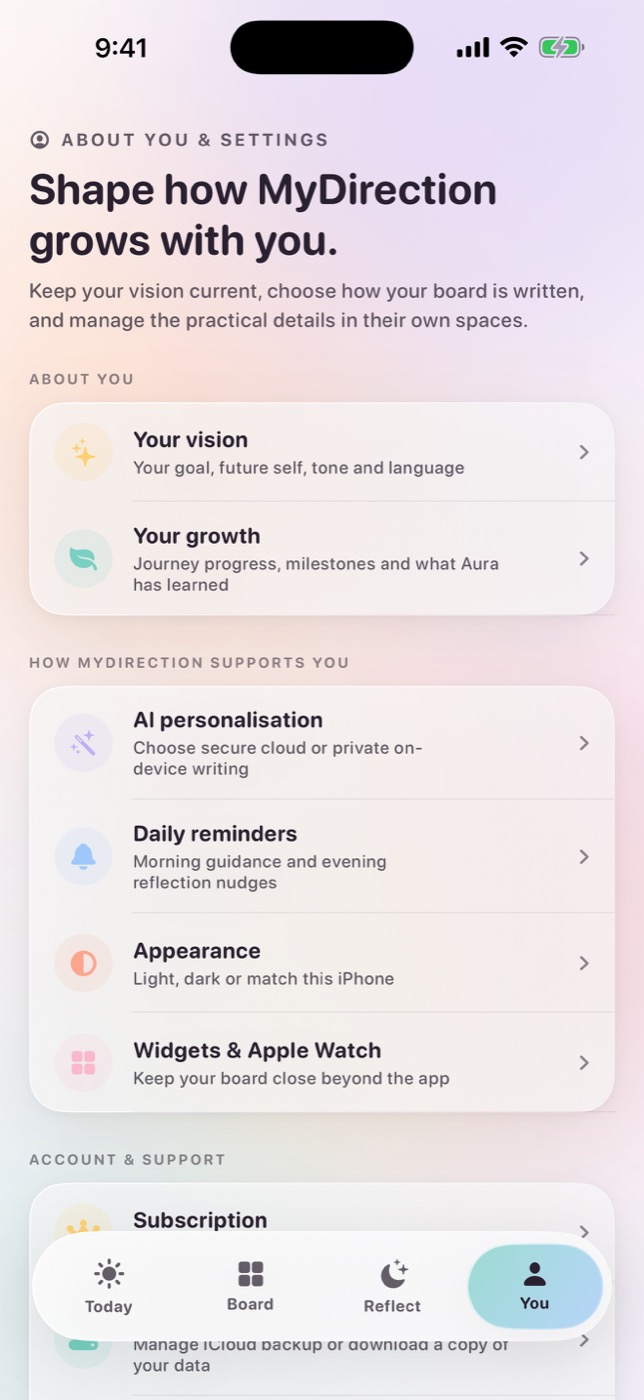
The short answer
MyDirection uses AI to write your daily focus line, step suggestions and reflection prompts from your own goal and language. You choose between on-device private writing and secure cloud personalization. Neither mode needs your photo library, contacts, location or advertising identity.
What the AI is actually writing
It helps to be specific about where generation appears, because "AI-powered" covers everything from a genuine language model to a randomized quote list. In MyDirection, generation produces four things.
- Today's focus line. The single sentence you read during the one-minute practice, drawn from your direction and your recent reflections.
- Step suggestions, concrete candidate actions for today, sized to finish today, based on what you have actually completed before.
- Reflection prompts. The evening question, which changes depending on whether your last few days went well, stalled, or drifted.
- Board language. The words that sit alongside your imagery and shift as your evidence accumulates.
What it does not write is advice about your life circumstances, interpretations of your emotional state, or anything resembling therapy. That boundary is deliberate and it is enforced in the prompt design, not left to the model's judgement. If you are in distress, an app that generates encouraging sentences is not the right tool, and MyDirection will not pretend otherwise.
What personalization uses, and what it never asks for
Personalization draws on the material you have deliberately given the app, meaning the goal you described, the tone you chose, the reflections you wrote, the steps you took or skipped, and the evidence you logged. That is a small, self-selected corpus, and it is enough. The quality of personalization here comes from specificity, not from volume.
It does not need your photo library, your contacts, your location, your calendar, your health data or an advertising identifier. Those are the permissions that make an app feel invasive, and none of them make a daily focus line better. Where an app asks for them, it is usually because a second business model is attached to the first.
| Signal | Used? | Why |
|---|---|---|
| Your goal description | Yes | It is the substance of every generated line. |
| Tone and journey preferences | Yes | Determines register, whether plain, warm or direct. |
| Your reflections | Yes, when relevant | The only reliable source of what is actually happening. |
| Step outcomes and evidence | Yes | Lets the app size the next step realistically. |
| Photo images | No | Never uploaded for generation, in either mode. |
| Contacts, location, calendar | No | Not requested. They do not improve the output. |
| Advertising identifier | No | There is no advertising model to serve. |
The two modes, compared directly
Both modes run the same daily loop and neither is the compromised version. What changes is where the sentence is composed, which has a few practical consequences worth seeing side by side.
| Private writing | Secure AI personalization | |
|---|---|---|
| Where generation happens | On your iPhone, where supported | Our generation service, then a model provider |
| Device requirements | Recent hardware and a supported language | None, it works on any device |
| Personal text sent off-device | No | Yes, the text needed for the request |
| Works offline | Yes, with template fallback | No, it needs a connection |
| Language variety | Narrows a little over months | Stays wide |
| Connects patterns across reflections | Limited by phone memory | Yes |
| Photo images uploaded | No | No |
| Used to train a model | No | No, training is disabled |
| Prompt retention | Nothing leaves the device | None, zero-retention routing |
We are not going to tell you to keep the difficult material local. Private writing is excellent and we built it because a practice that runs entirely on your phone is a genuinely good thing to be able to offer. It also needs recent hardware and a supported language, and not everyone has those, which is exactly why secure personalization exists rather than being an afterthought. It works extremely well, it is available on any device, and the request is sent with training disabled and zero data retention, so what you write is used to answer you and then it is gone. No model is trained on your reflections in either mode. Pick the one that suits your phone and your habits, write whatever you like in it, and switch whenever you feel like it.
Why generic AI affirmations fail after two weeks
The failure mode of AI in this category is well documented by anyone who has used one of these apps for a month, which is that the output is impressive on day one and interchangeable by day fourteen. The reason is structural. If a model is only given a category ("career," "abundance," "self-love") there are only so many sentences in that space, and you will see all of them.
Personalization only compounds when the model has access to something that changes. In MyDirection, the thing that changes is your own record of what you did, what you skipped and what you wrote at 9pm. A line that references the specific obstacle you named on Tuesday is not a better sentence because the model is bigger. It is better because the input was real.
This is also why the app asks for a reflection every day rather than a mood rating every week. The reflection is the fuel. A practice that only asks you to consume generated content eventually generates content about nothing.
The boundaries we enforce in the prompt itself
A language model given a person's reflections will happily produce interpretation, diagnosis and advice, because that is what the surrounding text looks like. Preventing it is a design decision that has to be made explicitly rather than left to the model's judgement.
- No interpretation of emotional state. The app does not tell you what your reflection reveals about you.
- No clinical language. Nothing that reads as assessment, diagnosis or therapeutic technique.
- No advice about personal circumstances. It does not weigh in on your relationship, your job offer or your health.
- No certainty about outcomes. It will not tell you that something is going to work.
- No escalation of urgency. A generated line never implies you are falling behind or running out of time.
- A clear boundary where content suggests distress. The correct response there is a person, not a better sentence.
These constraints make the writing less dramatic than it could be. That is the intended trade, because an app that generates encouraging sentences is not equipped to be anything more than that, and pretending otherwise is where products in this category do real harm.
You can change your mind, and it is not buried
Privacy choices in most apps are a one-time onboarding moment engineered to produce a yes, followed by a settings screen you would need a map to find. MyDirection keeps the generation-mode control in Settings, in plain language, with the same two options described the same way. Switching does not reset your journey, does not delete your board and does not retroactively upload anything.
You can also withdraw cloud AI permission entirely and keep using the app. The practice continues on private writing with template fallback. Nothing about the subscription depends on which mode you choose, and there is no cheaper tier that pays for itself by taking more of your data.
Common questions
Which AI model does MyDirection use?
Private writing uses Apple's on-device model where your device supports it. Secure personalization routes through our generation service to a model provider under training-disabled, zero-retention terms. The specific providers are named in the full privacy policy.
Does the AI read my photos?
No. Photo images are never uploaded for generation. If you write a caption or note about a photo, that text can be included in a request while secure personalization is on.
Will the AI tell me what to do with my life?
No. It writes a focus line, candidate steps sized to your recent history, and a reflection prompt. It does not diagnose, advise on personal circumstances, or offer anything resembling clinical support.
Is AI personalization included in the subscription?
Yes. There is one subscription and both generation modes are included. MyDirection is $7.99 per week, $19.99 per month or $59.99 per year on the US App Store, with a 3-day free trial for eligible new subscribers.
Does personalization get better over time?
Yes, and slowly rather than dramatically. Step sizing adjusts within the first week, register shifts over two to three weeks, and your own phrasing starts appearing around week four. Anything that appears deeply personalized on day two is responding to your onboarding answers.
Can I turn AI off entirely?
You can withdraw cloud AI permission and keep using the app. The practice continues on private writing, with built-in templates as fallback where on-device generation is unavailable.
What if the AI writes something that does not fit?
Skip it. The loop is designed so that a line you disagree with is itself a signal, and your reflections are what change tomorrow's output.
For iPhone and Apple Watch
Keep your vision close.
Become it daily.
MyDirection is a paid subscription with a 3-day free trial. Cancel any time before the trial ends and you are not charged.
See pricing and trial