
The practice
How MyDirection works
A vision becomes useful the moment it changes something about today. Here is the whole mechanism, step by step.
See pricing and trial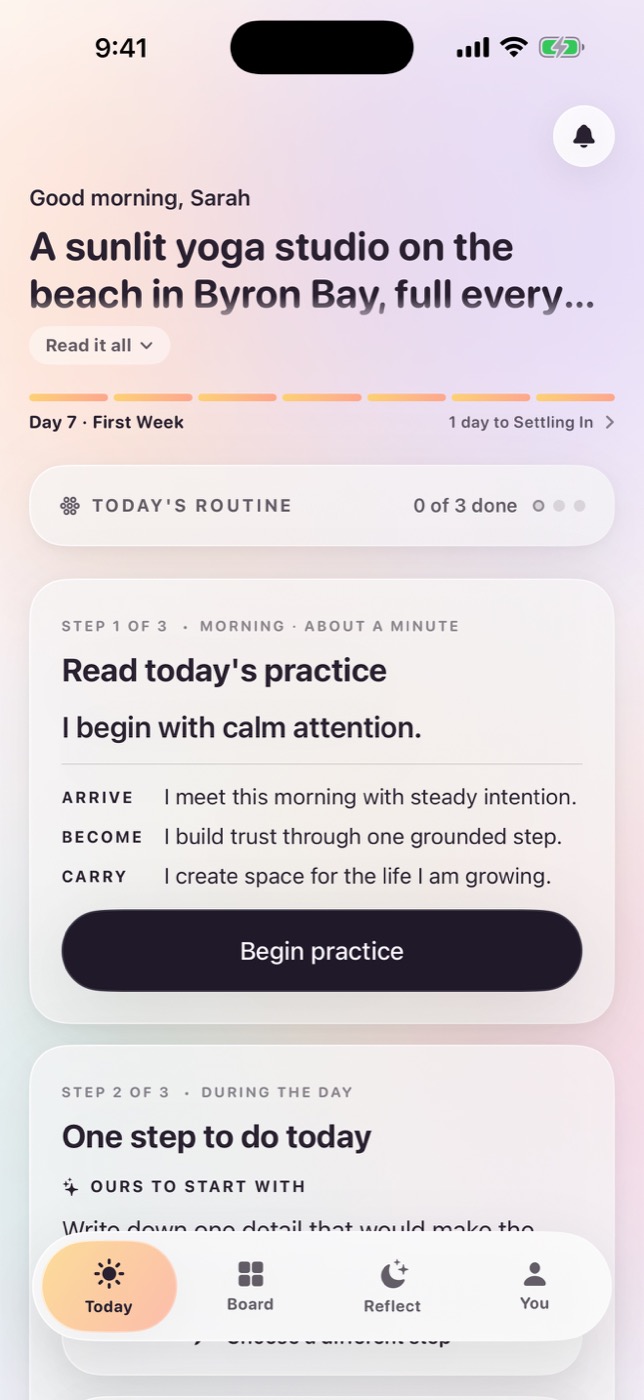
The short answer
MyDirection runs a four-part daily loop made of a one-minute focus practice in the morning, one aligned step sized to finish today, a short evening reflection, and a growing record of evidence. Your reflections and choices feed back into what the board shows you tomorrow.
1. Set a direction, not a plan
Setup asks for one direction. Not a life audit across eight categories, not a five-year plan. One thing you are currently building. It might be a business, a body of creative work, a move to another city, a relationship you want to repair, or a version of your working week that does not leave you empty on Friday.
You describe it in your own words. This matters more than it sounds, because the app's later writing is built from your language. A direction typed as "be more successful" produces generic guidance forever. A direction typed as "get the studio to a point where I can drop the contract work" gives the app something specific to work with, and gives you something you can recognise on a Tuesday.
Then you add imagery. Photos from your own library work better than stock images, because the value of a vision board is recognition rather than aesthetics. A picture of the actual street you want to live on does something a beautifully lit generic apartment does not. You also choose a tone (plain, warm, or direct) which sets the register of everything the app writes to you.
2. One minute of focus in the morning
The morning practice takes about a minute. MyDirection brings forward a single line drawn from your evolving board, and pairs it with one slow breath. That is the entire ritual.
The brevity is a design decision, not a limitation. Practices fail on the days that go wrong, and a practice that requires fifteen calm minutes is unavailable exactly when you most need it. The morning you overslept, the week the deadline moved, the day you woke up already behind. A one-minute practice survives those days, and surviving them is the whole game. Consistency at low intensity beats intensity you abandon.
The line itself is not an affirmation in the traditional sense. It is not a statement about who you are that your mind can immediately reject. It is closer to a question with a direction attached, asking what this would look like today given the week you are actually having. You can respond to it, skip it, or mark that it did not land, and each of those responses is a signal the board uses.
3. One aligned step, sized to finish today
After the focus, MyDirection asks for one step. One. Not a task list, not a habit stack, not a weekly plan. The constraint is deliberate and it is the part of the app people underestimate.
A step is a good step if three things are true. It is specific enough that you would know whether you did it, small enough to finish inside the day you already have, and connected to the direction rather than merely to being busy. The app suggests candidates based on what you have actually completed before, which means the suggestions get more realistic as it learns that you finish thirty-minute tasks and abandon two-hour ones.
- Specific, "send the pitch to three people on the list" rather than "work on outreach".
- Finishable, sized to the day you have, not the day you wish you had.
- Connected, moves the actual constraint, not the most comfortable adjacent task.
- Yours, chosen by you. The app suggests; it does not assign.
There is no streak counter, and this is intentional. Streaks convert a practice into a score, and the moment you break one, the rational response is to stop playing. MyDirection records what happened without grading you on it, because the record is more useful than the shame.
4. A short reflection in the evening
In the evening you record what happened and how aligned the day felt. A single tap is a complete reflection. A rating and nothing else is valid input. Writing a few sentences teaches the board more, and on the days you have the energy for it, the difference in the next day's output is noticeable.
The prompt changes based on your recent pattern. After a run of completed steps it asks about what is working and whether the step size should increase. After a stall it asks about friction rather than motivation, because "what made this harder than expected" is a question with a usable answer and "why didn't you do it" is not. After a drift it asks the uncomfortable one, whether this direction still feels like yours.
That last prompt is the one people tell us they did not expect from an app in this category. A goal you have outgrown does not announce itself; it just quietly produces worse weeks. Being asked directly, by something that has been watching the pattern, is often the moment the change becomes possible.
5. Evidence accumulates into something you can use
Everything you log builds a record of steps taken, reflections written and evidence entries. The concrete moments that show movement. The reply that came back. The habit that held for eleven days. The assumption that turned out to be wrong, which is progress even though it does not feel like it.
Evidence matters because motivation is not reliably available and belief built on repetition is fragile. Reading the same affirmation for the hundredth time does not make it more credible. Reading a list of eleven specific things that actually happened does, because your own record is harder to argue with than your own optimism.
Crucially, the record includes what did not work. An evidence log that only contains wins is a highlight reel, and highlight reels do not help you make decisions. Recording the pitch that got no reply is what lets you notice, six weeks later, that the channel is wrong rather than the offer.
6. How the board changes
This is the part that separates MyDirection from a collage with a reminder attached. Three signals feed back into what you see.
| Signal | What it is | What changes because of it |
|---|---|---|
| Response | Which lines you engage with, skip, or mark as not landing | The register and subject of tomorrow's focus line |
| Behaviour | Which steps you complete, which you abandon, and how large they were | The size and type of steps suggested next |
| Reflection | What you write in the evening and how aligned you rate the day | Which part of your direction surfaces, and when the app asks whether the goal still fits |
The learning is decayed rather than cumulative, which means recent signals matter more than old ones. A month of enthusiasm in March does not keep shaping your board in July. This is closer to how a direction actually behaves. The version of your goal that is true now should outweigh the version you typed on day one.
For the underlying idea and how it differs from a static board, see what is an adaptive vision board.
6b. What the app is not doing with your signals
"It learns from you" is a sentence that should prompt questions rather than reassurance, so here is the boundary of what the learning does.
- It does not build a psychological profile. The signals shape which line surfaces and how big a step is suggested. They are not assembled into an assessment of you.
- It does not score you. There is no rating of your consistency, discipline or progress, visible or hidden.
- It does not optimise for engagement. The objective is a completed loop, not a longer session or a higher open rate. Those objectives diverge quickly and we chose one.
- It does not share anything. No social layer, no comparison to other users, no aggregate ranking.
- It does not chase a bad fortnight. Decay is slow enough that a difficult week does not rewrite your direction.
- It does not decide. It surfaces and suggests. Choosing the step, writing the reflection and changing the direction are all yours.
7. Where the practice lives during the day
Between the morning minute and the evening reflection, the practice needs to be visible without demanding another session. MyDirection uses Lock Screen and Home Screen widgets, Apple Watch complications, and a Watch app to keep today's line and today's step glanceable.
You can log a quick signal from your wrist when something lands and write the fuller reflection later on iPhone. The design assumption is that the useful moment is rarely the moment you are sitting down with your phone. It is the walk, the queue, the pause before the conversation. More on this in MyDirection on Apple Watch.
8. What happens on the days it goes wrong
Any practice can be described convincingly on a good day. The design questions that matter are all about the other ones, so here is how the loop behaves when things break down.
- You miss a day
- Nothing resets, nothing is flagged and no notification tells you that you have lapsed. The next morning is a normal morning. There is no streak to protect and therefore nothing to abandon.
- You miss a fortnight
- You come back to the smallest version, read the line. The app does not open with a summary of what you failed to do. Your evidence and history are exactly where you left them, which is usually the thing that makes returning possible.
- The step was too big
- Repeated misses of a similar size are a signal, and the suggestions get smaller rather than more insistent. Nothing tells you to try harder.
- The line does not land
- Mark it. That is a signal, not a complaint form. The register and subject of tomorrow's line change in response to it.
- The goal has stopped fitting
- After a run of low alignment ratings the evening prompt asks about the direction rather than about the day. This is the intended behaviour and the most useful thing the app does.
- You have no connection
- In private writing mode the whole loop completes offline. In secure personalization mode generation needs a connection, and built-in templates keep the practice available rather than showing an error.
The general principle is that the app should never make a bad week worse. Guilt is easy to generate and it does not produce behaviour change. It produces avoidance, and avoidance of an app that holds your goals means the goals go quiet too.
8b. What the app will not do to you
Several of the behaviours that are standard in this category are absent on purpose, and knowing that in advance is part of understanding how the loop works.
- It will not tell you that you are falling behind. No streaks, no completion percentage, no comparison to a plan.
- It will not interpret your emotional state. The app does not tell you what your reflection reveals about you, and the prompts are written to prevent the model from trying.
- It will not promise outcomes. No line generated by MyDirection will tell you that something is going to work.
- It will not escalate urgency to get you back. Nudges are capped at two a day and none of them mention your absence.
- It will not share anything. No feed, no accountability partner, no comparison with other users.
- It will not act as support in a crisis. Where content suggests genuine distress, the appropriate response is a qualified person, and the app says so rather than generating a more encouraging sentence.
9. Why 66 days
The journey is framed as 66 days because that number comes from habit-formation research on how long automaticity took to develop across a range of everyday behaviours, with enormous individual variation, from under three weeks to well over half a year. It is a median, not a law, and anyone selling you 21 days as a rule is quoting a self-help book rather than a study.
We use it as a frame rather than a promise. Sixty-six days is long enough for a pattern to appear in your own reflections, which is the thing the board needs in order to adapt in an interesting way. It is not a countdown to transformation, and nothing expires at day 67. The practice continues, with a board that now has three months of your own evidence in it.
Common questions
How long does the daily practice actually take?
About a minute in the morning, a step that happens inside your day rather than on top of it, and an evening reflection that can be one tap. Most days total under three minutes of screen time.
What if I miss a day?
Nothing breaks and nothing resets. There is no streak counter, because a broken streak is a reason to quit and a missed day is just information.
Can I track more than one goal?
The practice is built around one direction at a time. This is a constraint we chose, because two directions produce two half-practices, and the daily loop only works if the step is unambiguous.
Do I need to write a lot?
No. A single tap is a complete reflection. Writing more improves the personalization, but the loop is designed to work at the lowest effort level you can sustain.
Does it work if I use private on-device writing?
Yes, completely. The full loop runs in both modes and no features are held back. Over months the language narrows a little, which is the only difference most people notice.
What does it cost?
MyDirection is $7.99 per week, $19.99 per month or $59.99 per year on the US App Store, with a 3-day free trial for eligible new subscribers. There is no free tier. See pricing.
For iPhone and Apple Watch
Keep your vision close.
Become it daily.
MyDirection is a paid subscription with a 3-day free trial. Cancel any time before the trial ends and you are not charged.
See pricing and trial