
A practical method
How to make a vision board
Make a board you can live. Not one you admire for a fortnight and then stop seeing.
See pricing and trial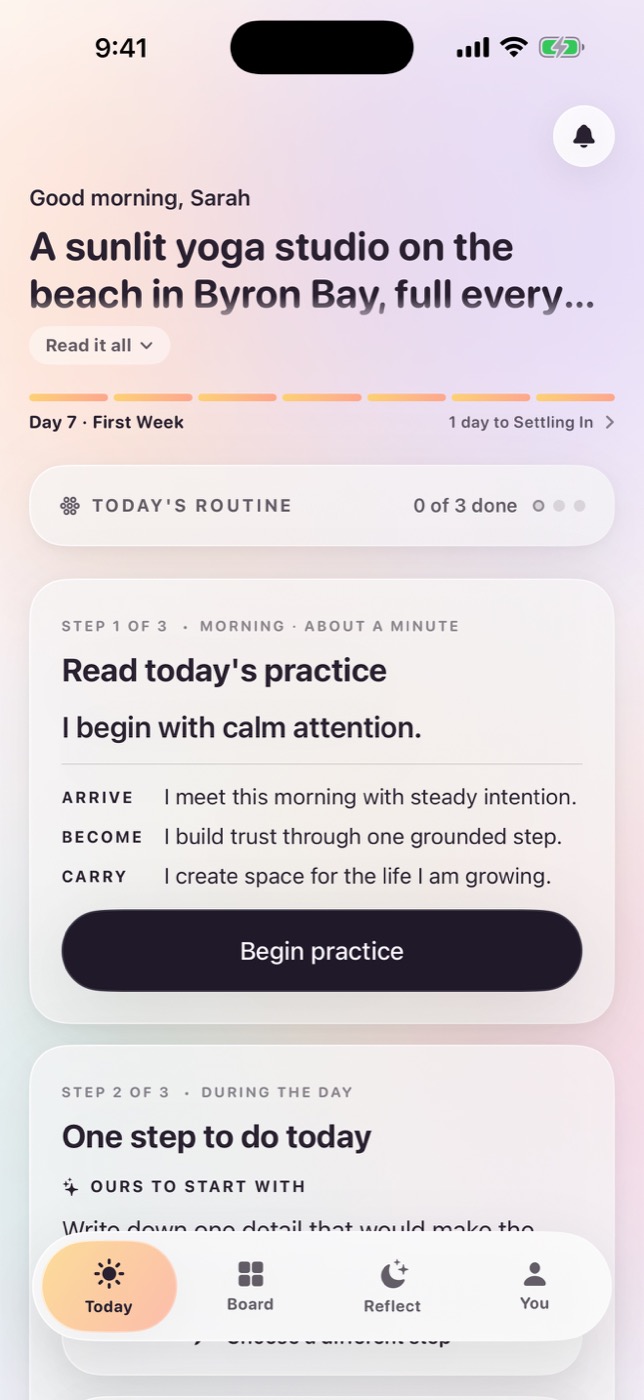
The short answer
Make a vision board in four steps. Name one direction in a sentence, collect concrete imagery of the environment and routine rather than only the prize, add language you actually believe, and attach the board to one daily action. Expect to revise it monthly.
1. Name one direction, in one sentence
Before any images, write a sentence describing what you are building and why it matters. One direction. The instinct is to cover career, health, relationships, home and finances simultaneously, and that instinct is why most boards fail. A board about everything cannot tell you anything about today.
Write it in your own language, not in goal-setting language. "Get the studio to the point where I can drop the contract work" is a direction. "Achieve financial freedom" is a category. The test is whether the sentence would let a friend tell the difference between a week that moved it forward and a week that did not.
Then apply the harder test and ask whether this goal is actually yours. A surprising proportion of vision boards contain someone else's ambition, whether a parent's, an industry's, or a version of success absorbed from a feed. Those goals produce a specific pattern, where you build the board with enthusiasm and then feel obscurely reluctant to act on it. If you notice that pattern, it is information, not laziness.
2. Collect concrete imagery
Now find images that make the direction observable. The most common mistake is collecting only the prize, the house, the stage, the number. The prize is one image. The life around it is where the useful material lives.
- Start with the environment. The room, street, studio or workspace where this direction plays out day to day.
- Add the routine, what an ordinary working Tuesday looks like inside this life, not the milestone day.
- Add the people. The customers, collaborators, friends or family who are present in it.
- Add the craft. The actual work, the materials, the unfinished version, the practice behind the outcome.
- Add one image of the prize, if you want it. One.
- Stop at twelve to fifteen. Then remove three.
Prefer your own photographs wherever you can. A picture of a street you have walked, a desk you have sat at, or a person you actually know produces recognition, and recognition is a stronger and more durable response than aspiration. Stock imagery of a life that belongs to nobody tends to produce a pleasant blankness that fades within weeks.
Be careful with images sourced from social feeds. They are selected for engagement, which usually means they are optimised to produce a small amount of envy. An image that makes you feel behind is charging you a tax every time you glance at it.
3. Add words you actually believe
Language on a board should create movement without demanding false certainty. This is where conventional affirmation advice does damage, because if you write "I am a successful founder" and some part of you immediately answers "no you are not," you have created a small argument that runs every time you look at the board.
There is research suggesting that self-statements which conflict with someone's existing self-view can leave them feeling worse rather than better. The statement gets rejected and the rejection is what sticks. Progressive phrasing avoids the fight.
| Instead of | Try | Why |
|---|---|---|
| I am a successful writer | I am building a body of work | Describes a process that is verifiably happening |
| I am wealthy | I am making decisions that build stability | Points at behaviour you control |
| I attract opportunity | I follow up within two days | Turns a claim into an action |
| I am always confident | I speak up before I feel ready | Accepts the feeling and names the behaviour anyway |
Include one sentence about the process and one about the reason. The reason matters on the weeks when the process is unrewarding, which is most of the interesting weeks.
4. Attach it to one daily step
A board with no attached action is a poster. The single highest-leverage thing you can do after building one is to decide what it should change about a normal day.
Use an implementation intention, which is a plan in the form "when X happens, I will do Y." The evidence for this format is unusually good across a wide range of behaviours, and it works because it removes the decision at the moment of action. "I will work on the studio more" is a wish. "When I finish breakfast, I will spend twenty-five minutes on the current commission before opening email" is a plan with a trigger.
Then size it down until it survives a bad day. Whatever you first wrote, halve it. The goal in the first fortnight is not progress, it is establishing that the practice happens at all, and a step that only fits perfect days will teach you that the practice is optional.
Full detail on step sizing, friction and the weekly review is in turning a vision board into daily action.
Keeping the board alive after week two
Almost every board dies the same way. It stops being seen. Not thrown out, just absorbed into the visual background of a room, or buried three taps deep in a phone. Habituation is fast and it is not a character flaw.
Three things reliably counter it. Put the board where decisions happen rather than where it looks best. A Lock Screen beats a bedroom wall, because the bedroom is not where your day is decided. Change something small each week so there is a reason to look. And attach a question rather than a feeling, since "what would move this forward today" gives you something to do with the glance.
Review the whole board monthly. Remove what has gone stale, add evidence of what has actually happened, and check the direction sentence still describes something you want. A board that only accumulates becomes an archive; a board that is edited stays a tool. That maintenance burden is exactly what an adaptive board is designed to reduce.
What you actually need
The materials question gets over-thought. Both versions are cheap and neither needs a trip to a craft shop.
Physical boards need a corkboard, foam board or large sheet of paper; printed photographs or magazine pages; scissors; pins or glue; a marker. If printing is inconvenient, a local print shop will do a page of images for the price of a coffee. Choose a size you can hang somewhere you pass rather than the biggest board that fits the shelf.
Digital boards need an album in Photos, or a canvas in Freeform if you want to arrange things. Anything that can become a Lock Screen wallpaper or a widget is enough. You do not need an app to start, and starting without one is a reasonable way to find out whether the practice suits you before paying for anything.
Set aside an hour or two. If it is turning into a full weekend, the collecting has become the activity, which is an enjoyable form of procrastination and produces a board you will not use.
Five mistakes worth avoiding
- Covering every life area at once. Attention is the scarce resource. One direction at a time.
- Only picturing the outcome. Outcome fantasy without obstacle and plan can reduce effort. Include the process.
- Using images that produce envy. They cost you something every time you look.
- Writing affirmations you reject. A statement your mind argues with is worse than no statement.
- Building it and never attaching it to a day. This is the one that kills most boards.
Common questions
How long should making a vision board take?
An hour or two, once you know your direction. If it is taking a full weekend, the collecting has become the activity, which is its own kind of procrastination.
What should I make it on?
Whatever you will see daily. A corkboard is fine if it hangs where your day happens; a Photos album or app is better if your day happens away from home.
Should I look at it in the morning or evening?
Morning, briefly, so it can influence the day's choices. Evening is better used for reflection on what actually happened.
Do I need to feel emotional when I look at it?
No. Chasing a feeling is what turns the board into a mood ritual. A useful glance ends in a question about today, not a state.
How often should I remake it?
Review monthly, remake when the direction genuinely changes, often somewhere between six and twelve months. Remaking too often means never testing anything.
Sources and further reading
For iPhone and Apple Watch
Keep your vision close.
Become it daily.
MyDirection is a paid subscription with a 3-day free trial. Cancel any time before the trial ends and you are not charged.
See pricing and trial