
Make the future specific
Vision board ideas
Include the life around the outcome, not only the outcome.
See pricing and trial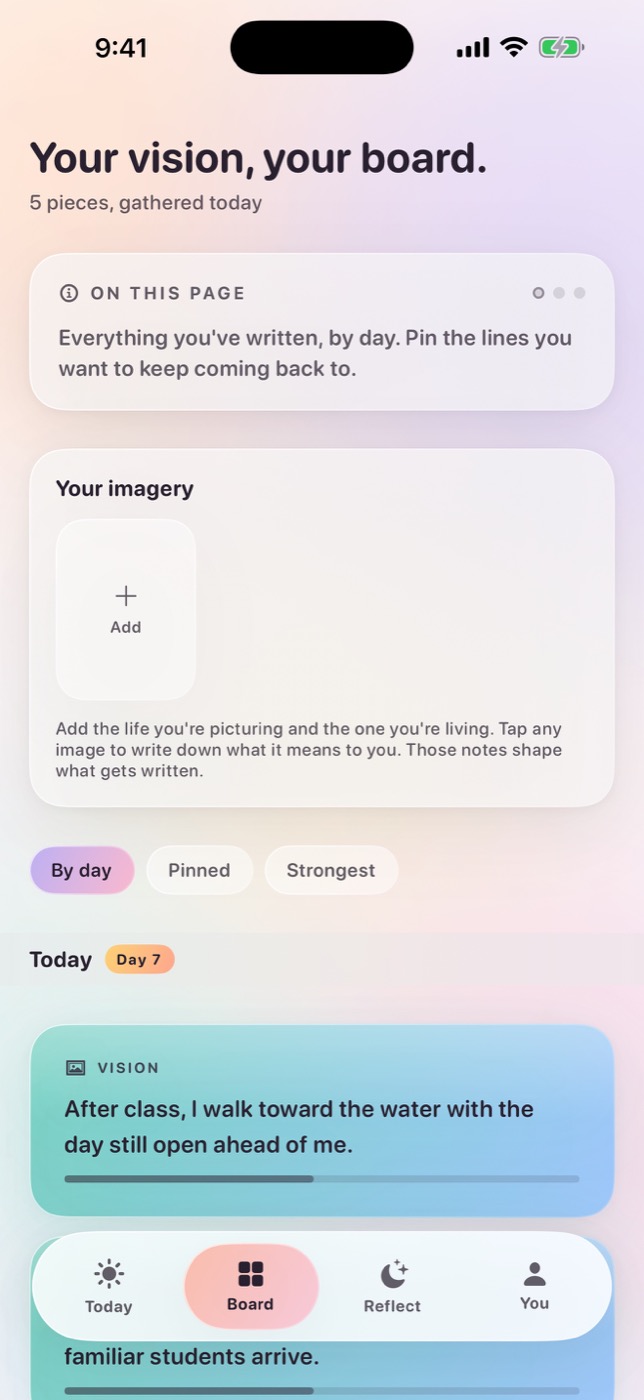
The short answer
The most useful vision board ideas show the environment, routine and craft behind a goal rather than only the milestone. For each area, picture what an ordinary Tuesday looks like inside the life you want. That is the image that changes a decision.
The principle behind every idea below
Most vision boards are built from milestone images of the house, the stage, the beach, the number. Milestones are easy to picture and almost useless as daily guidance, because nothing about them tells you what to do on a Wednesday morning.
There is also a risk in loading a board with outcome imagery. Research on positive fantasies suggests that vividly dwelling on an idealized future can reduce the energy people bring to pursuing it, because the mind takes some of the reward in advance. Boards built entirely from prizes are the clearest version of this.
So for each area, use this ratio of one image of the outcome to four of the life around it, meaning the environment, the routine, the craft and the people. The outcome supplies the pull. The rest supplies the instructions.
Career and business
Show the work itself, not the title. A job title is a label other people apply; the thing you will live inside is the daily texture of the work.
- The room or workspace where the work happens, including the unglamorous version.
- A calendar shaped the way you want it, with the deep-work block and the empty Friday afternoon.
- The customers or colleagues you want to be in the room with.
- The craft. The tools, the screen, the draft, the thing half-finished.
- One image of the outcome, whether the launch, the signed contract or the office.
- A boundary you intend to hold. The closed laptop, the phone in the drawer.
If revenue is the goal, put a number on it and put the work that produces it next to it. A figure with no attached process is the purest form of outcome fantasy. See vision boards for entrepreneurs and for career goals.
Creativity
Creative goals fail on courage and consistency far more often than on talent, so build the board around those two things rather than around the applause.
- The materials and the mess. The studio mid-project, not styled for a photograph.
- Unfinished work, deliberately. A board of finished masterpieces sets the bar at the wrong place.
- Protected time, meaning the hour, the closed door, the phone left in another room.
- The people who make you brave enough to publish.
- One image of the work reaching someone, whether a reader, a listener or a room.
- The reference wall of work you admire, which reminds you what you are aiming at.
Add a sentence about frequency rather than quality, since "I publish something every fortnight" is actionable in a way "I make great work" is not. More in vision boards for creatives.
Wellbeing and health
This is the area where boards most often do harm. A board built from other people's bodies is not a motivation tool; it is a daily comparison you have volunteered for, and it tends to produce shame rather than movement.
Build it from behaviours and environments instead, the things you can actually do this week.
- The activity you want to enjoy, shown as participation rather than as a physique.
- The environment that supports it, whether the route, the pool, the trail or the class.
- Food you would genuinely like to eat and cook, not an aspirational diet you resent.
- Sleep and rest, pictured concretely as the dark room and the unset alarm.
- The social version, meaning the friend you walk with, the team, the shared meal.
- Energy as the outcome image, what you want to be able to do, not what you want to look like.
Home and environment
Home boards drift toward interiors magazines, which capture how a space photographs rather than how it feels to live in. Aim for the second.
- How the space is used, with the table mid-meal, the corner where you read, the door that gets left open.
- Light and time of day. The specific quality of a morning in this place.
- The location, meaning the street, the walk to the shop, the view from the window.
- What is absent. The clutter that is gone, the room that is quiet.
- One outcome image, whether the house, the keys or the lease.
- The financial step that makes it real, whether the savings routine or the meeting with the broker.
Relationships
Relationship goals involve other people, which puts most of the outcome outside your control. Build the board around what you can actually do, which is how you want to show up, and what you want to make room for.
- Shared ordinary time, meaning the meal, the walk, the drive, the Sunday.
- The conversations you want to be able to have, including the difficult ones.
- Boundaries, what you protect, what you decline, what you stop tolerating.
- Play and rest together, not only the milestone events.
- The friendships you want to maintain, and the specific act that maintains them.
- How you want to be, not what you want them to be.
That last line is the whole discipline of a relationship board. A board describing a specific person behaving a specific way is a wish about someone else's autonomy. A board describing how you want to show up is something you can act on tomorrow.
Money
Money boards are the most likely to become pure fantasy and the easiest to fix. The fix is to picture the mechanism alongside the amount.
- The specific number, with a date attached.
- What the money is actually for, whether that is freedom, safety, or the choice it buys.
- The income mechanism, whether the work, the clients, the raise conversation or the side project.
- The routine, meaning the transfer that happens automatically every payday.
- The thing you will stop doing when this is true.
- One image of the outcome. Only one.
A note we will repeat is that nothing about a board influences markets, employers or the economy. What it can do is keep a specific financial decision salient enough that you actually make it. That is a smaller claim and a real one.
Study and learning
Study goals have an unusually clear structure (there is a syllabus, a schedule and an exam), which makes it tempting to skip the board entirely. The thing a board adds here is the reason, which is exactly what erodes in month four of a long course.
- The work the qualification unlocks, shown as a working day rather than a certificate.
- Your actual study environment at its realistic best, whether the desk, the library seat, the two hours on a Sunday.
- The specific weekly routine that would get you through, drawn as a calendar rather than as an intention.
- The people, study group, tutor, the person a year ahead of you.
- One image of completion. One.
- What you are giving up to do this, acknowledged rather than hidden. Naming the cost makes it easier to keep paying.
Putting it together
- Pick one area. A board covering six areas gives you guidance about none of them.
- Choose twelve to fifteen images at the four-to-one ratio of process to prize.
- Add one sentence about the process and one about the reason.
- Put it where decisions happen. Lock Screen, widget, or a wall you pass on the way out.
- Attach one daily action with a trigger.
- Review monthly; remove anything that has become invisible or that makes you feel behind.
Then the practice, which is the part that actually matters. See how to make a vision board and turning it into daily action.
Common questions
What should I put on a vision board?
The environment, routine, craft and people behind the goal, plus one image of the outcome. Aim for roughly four process images to every outcome image.
How many images should be on a vision board?
Twelve to fifteen for most people. Beyond that there is no focal point, and a board with no focal point communicates nothing in the seconds you give it.
Can I use words instead of images?
Yes. A board of six sentences you believe can work better than forty images you do not. Use language that describes a process rather than a claim you will argue with.
Should I include things I already have?
Yes. A small section of evidence. On the weeks nothing is moving, the part of the board showing what is already true is the part that holds.
Is it bad to put money on a vision board?
Only if the number appears alone. Put the mechanism next to it, the work, the clients, the automatic transfer.
Sources and further reading
For iPhone and Apple Watch
Keep your vision close.
Become it daily.
MyDirection is a paid subscription with a 3-day free trial. Cancel any time before the trial ends and you are not charged.
See pricing and trial